Florida has incredible fishing adventures that can be experience all year round. When traveling down or up the west coast of Florida, experience a King Mackerel Fishing Charter that will leave you wanting more.
Cape Canaveral, Florida is a beautiful place to visit. It has many different attractions from its gorgeous sandy beaches to the inshore and offshore fishing adventures.
I had the pleasure of fishing with Kelly and her party that wanted to experience what the waters of Cape Canaveral had to offer. One of the best parts about fishing here is the endless amounts of opportunity you have to catching the fish you have been after.
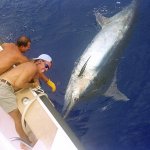
While we were slow trolling live bait, we were able to box a 30 pound King Mackerel. They enjoyed the rush and fight from this amazing fish. Aggressive Barracuda also came out to play and we caught a number of those. Not necessarily targeted but very exciting to catch for all ages.
Off the coast of Cape Canaveral, you can catch a multitude of species of fish. The possibilities are endless. Take a break from the beautiful beaches and enjoy the view from a beautiful boat that trolls the waters in search for all the major game fish.
We look forward to fishing with these wonderful people again in the future and if you want some of this action this summer, do not miss out!
Come Catch Yours Today with Captain Gabe exploring Cape Canaveral Deep Sea Fishing.
If you enjoyed this report, you might also enjoy a fishing report from the same area.
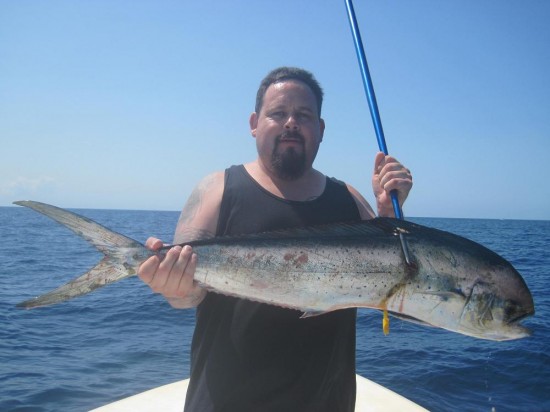
Great weather for fishing. West winds are starting to stack up some weeds offshore, and they proved to be somewhat fishy this trip. NE of the weather buoy some tightly scattered weeds proved to be just what the icebox needed. We started around the perimeter first, and the results came slowly, but good. First fish in was a 15lb Mahi. Like the last few weeks of fishing these anglers had never caught a “Dolphin”, and made it the target species of the trip. No company with this catch, so lines back to work.
Client David Bunch and his friend were traveling from Oklahoma to adventure out on a Cape Canaveral Offshore Fishing Charter with iOutdoor. They were in-store for an amazing day of fishing with great fish in the boat. You never know what to expect when Port Canaveral Offshore Trolling!
Another half hour, and the line goes off again. It did not seem too big till the angler put some bend in the rod, then a couple hundred yards of line peeled. This fish was not a jumper, but still we waited till we seen the colors to know what we had. It took a while with our Dolphin rigs to finally work it to the boat, but the Blue stripes was a very welcome sight. Wahoo in the boat. This 50lb fish made the day for these guys, and we still had time to fish.
Another pass around the area with no results, so we decided to cut through the weed field. A little time passed, and a lot of cleaning fouled lines of weed, but another hookup. Another Mahi-Mahi was on the line, dragging weeds with it. As we got it near the boat we saw it had company. The second fish did not take the other lines, so a pitch rod went to work. It looked, it followed, but nada. Other offerings were put in front of it but it turned its nose up at all we offered, and eventually made its way off. We sent lines back out, working the weed field some more with no more action while Port Canaveral Offshore Trolling.
Finally we headed to 8A to see if we could pick up a King or two to make a Slam. One line down, another out the back, and into slow gear we went. 20 minutes into the run, the downrigger released, and drag went out. This fish came to the surface and went airborne. A nice 20 lb bull Mahi was on the line. We worked it to the boat, and about a foot short of gaff range it decided it no longer wanted to play the game, and unhooked itself. Big smiles were on the anglers faces despite the loss of this fish. With lobster red sun burnt skin, they were ready to return to port and clean fish.
The desire to spread or scatter the ashes of a loved one in a special place is an ever increasingly popular choice. It is a dignified and simple alternative to the conventional funeral and iOutdoor can help you make arrangements with a captain and vessel to provide this service. A funeral at sea is a time-honored tradition. It is less costly than a conventional funeral and in many ways is much more refined. We provide for a private charter to take up to 6 attendees out for the scattering in most major ports in Florida. If you are unable to go out to sea, one of our captains will take the cremated remains offshore and scatter the ashes for you. Unattended we provide a respectful, dignified sea scattering service locally in most major ports in Florida. Call iOutdoor and for availability and costs.
Burial at Sea–Rules and Regulations.
Ocean Scattering… As no special permitting is required for this in Florida, you may also do the scattering yourself. There are certain requirements as set forth below for all ocean remains scattering. This is the actual Environmental Protection Agency rule on the burial of human remains at sea.
(a) All persons subject to title I of the Act are hereby granted a general permit to transport human remains from the United States and all persons owning or operating a vessel or aircraft registered in the United States or flying the United States flag and all departments, agencies, or instrumentalities of the United States are hereby granted a general permit to transport human remains from any location for the purpose of burial at sea and to bury such remains at sea subject to the following conditions:
(1) Except as herein otherwise provided, human remains shall be prepared for burial at sea and shall be buried in accordance with accepted practices and requirements as may be deemed appropriate and desirable by the United States Navy, United States Coast Guard, or civil authority charged with the responsibility for making such arrangements;
(2) Burial at sea of human remains which are not cremated shall take place no closer than 3 nautical miles from land and in water no less than one hundred fathoms (six hundred feet) deep and in no less than three hundred fathoms (eighteen hundred feet) from (i) 27 deg.30’00” to 31 deg.00’00” North Latitude off St. Augustine and Cape Canaveral, Florida; (ii) 82 deg.20’00” to 84 deg.00’00” West Longitude off Dry Tortugas, Florida; and (iii) 87 deg.15’00” to 89 deg.50’00” West Longitude off the Mississippi River Delta, Louisiana, to Pensacola, Florida. All necessary measures shall be taken to ensure that the remains sink to the bottom rapidly and permanently; and
Continued
(3) Cremated remains shall be buried in or on ocean waters without regard to the depth limitations specified in paragraph (a)(2) of this section provided that such burial shall take place no closer than 3 nautical miles from land.
(b) For purposes of this section and Secs. 229.2 and 229.3, land means that portion of the baseline from which the territorial sea is measured, as provided for in the Convention on the Territorial Sea and the Contiguous Zone, which is in closest proximity to the proposed disposal site.
(c) Flowers and wreaths consisting of materials which are readily decomposable in the marine environment may be disposed of under the general permit set forth in this section at the site at which disposal of human remains is authorized.
(d) All burials conducted under this general permit shall be reported within 30 days to the Regional Administrator of the Region from which the vessel carrying the remains departed.
The following notice to EPA is required to be filed within 30 days of the scheduled event.
All burials conducted shall be reported within 30 days to the EPA Region in writing. Provide the following information, it should be included and mailed or faxed to the appropriate region. You can copy the information below or complete and print the Region 4 burial at sea form (PDF)
NAME OF DECEASED:
DATE OF BURIAL/SCATTER:
TYPES OF REMAINS:
Cremated ( )
Non-Cremated ( )
LOCATION OF BURIAL/SCATTER
Latitude:
Longitude:
Distance from shore: (minimum of 3 nautical miles)
Depth of water:
VESSEL NAME:
VESSEL POINT OF CONTACT
Name:
Phone:
PORT OF DEPARTURE:
FOR NON-CREMATED REMAINS
Did the remains appear to rapidly sink to the ocean floor? Yes ( ) No ( )
DIRECTOR OR PERSON(S) RESPONSIBLE FOR BURIAL ARRANGEMENTS
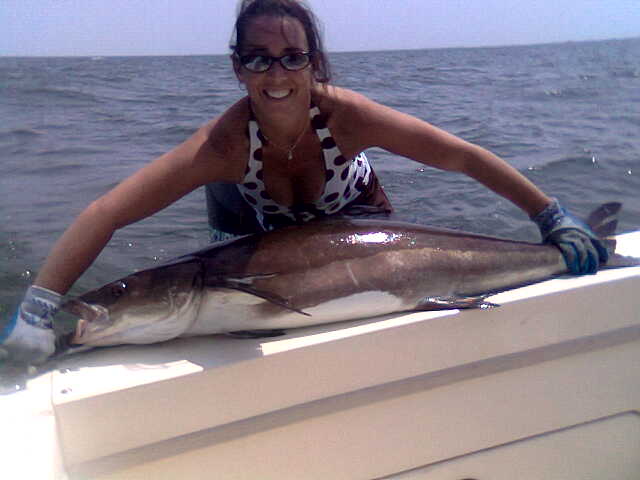
The Florida State Record for Cobia is 130 lb 1 oz and was caught near Destin. No wonder New Smyrna is one of the Cobia Capital of the World! Imagine a fish of that size! Cobia is some of the strongest fighting fish because of their beefy muscular makeup and their innate tenacity. The Cobia is a powerful fish and a thrilling catch and is one of the most sought after game fish and once hooked the thrill really begins with the line coming off a screaming reel and the angler unable to do anything but hang on! Cobia is considered an inshore/nearshore species and sight fishing is the best method to find these tasty brawlers and works even better if your vessel is equipped with a tower or raised platform. Cobia can be found in all waters off the coast of Florida and down into the Keys.
The appearance of the fish in local waters is temperature driven and most Cobia anglers start watching the water around mid-March for the fish to show up. Cobia is generally found in nearshore and inshore waters with inlets and bays – the fish like structure and are frequently found around buoys, pilings, and wrecks in these areas. Cobia spawns in spring and early summer and can be found throughout the summer months. Experienced Cobia anglers will look for turtles, manta rays, and floating debris to find Cobia- the fish enjoy the easy pickings from the rays as they dig up the bottom foraging for their own dinner.
Cobia is a versatile game fish caught on fly and spinning tackle both. They can be found in offshore waters, nearshore waters, and on the flats. So no matter what your equipment, type of boat, or level of experience there is A COBIA IN YOUR FUTURE!
Best bait and tactics for catching Cobia.
The BEST TACTIC for hooking and catching Cobia it to BE PREPARED! Cobia has a reputation for being extremely finicky when it comes to living baits and lures so have several rods baited and standing by with a variety of offerings. Cobia frequently travels in at least pairs and sometimes threesomes – have several stout rods rigged and ready to go at the fish opportunity. Live crabs and small fish are good bait for cobia but eels and live pinfish and a variety of artificial baits work well especially bucktail combinations with plastic tails. My favorite bait for cobia is an artificial eel made of surgical tubing with a lead sinker at the head.
Live baits for cobia include spot, menhaden, mullet, minnows, perch, eels, shrimp, crabs, and clams. These use of these live baits vary with season and location and the only experience can tell you what to use and when. Keep bait near the surface or, if cobia are deeper, add just enough weight to get the bait down and still retain its movement. Medium to heavy tackle is generally a good idea to land these fish that average 30 pounds and as every true Cobia hunter knows can easily go over 60 pounds. Fishing for cobia along pilings with a weighted eel is a favorite tactic of experienced anglers.
Cast the reel so it drops alongside the pilling and drops down- if you don’t get a strike the first time keep trying until you have covered all angles before moving on.
Good recipes for cooking and eating Cobia.
A word of caution, Cobia is a tough hard fighting fish, and large specimens when gaffed and boated have caused anglers to lose equipment, be injured, and have damaged boats. Have a plan when you get that fish over the side- have a fish box open and ready and the decks cleared so you can easily in one coordinated move land the fish and move it to the fish box.
Cobia is excellent table fare and is also great raw for sushi or sashimi. It can also be used as a replacement for fish such as tuna if people are looking for an environmentally sustainable alternative, as the texture and flavor are quite similar. Did you know that Cobia grows three times as fast as salmon and has been commercially produced in Asia, particularly in Taiwan where it is stocked in about 80% of ocean cages? Here are a few good Cobia recipes to try out- but nothing can beat a hot charcoal grill and a little Italian seasoning splashed on top!
Lemon Butter Cobia
Ingredients: 1 lb. cobia steaks 1/2 fresh lemon 1 tbsp. butter 1 tsp. olive oil 1/2 tsp. Old Bay crab seasoning or equivalent
Instructions: Preheat oven to 400 degrees.
Drain steaks and lay in a casserole dish coated with olive oil.
Squeeze lemon juice over steaks, coat with butter, and sprinkle with seasoning.
Bake for 10 minutes or until fish is white on the outside and still slightly pink in the center.
Baked Cobia with Italian Herbs
Ingredients
1 lb. cobia steaks 1 cup crushed bread crumbs 3/4 cup grated parmesan cheese 1/4 cup chopped fresh parsley 1 teaspoon salt 1/2 teaspoon pepper 1 teaspoon paprika 1/2 teaspoon fresh oregano 1/2 cup melted butter
Directions:
1. Rinse fillets and allow to drain in a colander. If necessary, blot away excess water with a paper towel.
2. Mix the dry ingredients together in a bowl.
3. Dredge fillets in butter and roll in dry season mixture. Place fillets on a greased cookie sheet.
4. Bake at 375-degrees for approximately 15-20 minutes. The fish is cooked when it is white and flakes easily
What Kind of Bait Do You Use to Catch SNAPPER in the Gulf of Mexico?
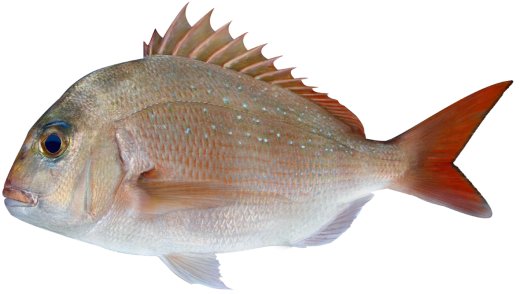
The Snapper, particularly the Gulf Red Snapper, is one of the most prized fish to catch in the Gulf of Mexico. Not only is it known for its tasty meat but also for its display of strength in the fishing sports world. It thrives in abundance in the Gulf of Mexico due to the favorable warmer climate and rich marine life in the area.
The key to successful Snapper Fishing in the Gulf of Mexico is a wide variety of bait. Remember that just like any game fish, Snappers are very discerning creatures, that one bait may not necessarily be effective the next time.
Of course, you can choose between artificial and live bait. It is observed, however, that Snappers take artificial baits with less vigor compared to natural bait to catch snapper in the Gulf of Mexico. That is why, when choosing artificial lures, always bring along different kinds and sizes since Snappers have a range of choices.
Although artificial baits nowadays may have the best in technological advancement, it doesn’t mean that live bait won’t do anymore. In fact, Tarpons respond the most to live baits. Snappers can eat absolutely almost anything although they have developed a preference for small fishes such as sardines and cigar mirrors, and crustaceans. In fact, the Red Snapper derives its reddish tint from its diet of mostly shrimps.
In the Gulf of Mexico, Snappers can be caught in waters as deep as 30 feet to 300 feet. They tend to cluster at the bottom of the ocean and prefer rocky reefs, ridges and ledges, and artificial refuges such as shipwrecks and oil rigs. Also, note that in the Gulf of Mexico, their appropriate regulations cover Snapper fishing.
What Kind of Bait Do You Use? to Catch SNAPPER in the Gulf of Mexico.
What is SeaSickness, Why Does it Happen, and How to Prevent It?
Seasickness is a form of motion sickness and occurs after spending some time on a craft on the water. This type of sickness is brought about by the rocking motion of the craft and is characterized by nausea and in extreme cases, vertigo. Some people are vulnerable to the condition after only a minor stimulus while some are immune, and others immune through exposure.
Causes or Triggers for Sea Sickness
Seasickness is not a virus and is not infectious. There are some factors that can bring on seasickness relatively quickly. These include going below deck for extended periods of time, looking through binoculars for long periods, and staring at objects your brain will interpret as stable (reading, needlework, and the like).
Preventing SeaSickness
There are some methods to help deal with seasickness without the use of medications. Here are some tips to help prevent seasickness:
Staying busy and keeping your mind occupied like fishing.
Staying on deck in the fresh air.
Take deep breaths and drink plenty of water.
Don’t cruise on an empty stomach.
Try and sleep off the sickness.
Cruise in relatively calm waters.
Cruise in vessels equipped with stabilizers to help eliminate the rocking motion that causes seasickness.
All of these tips will help distract your brain from the rocking motion. Keeping occupied is important as it helps trick the brain into believing that you are uncomfortable from the constant rocking motion of the vessel. The fresh air also helps eliminate the sickness rather than staying indoors or in your cabin the whole time. While it may also be best not to cruise on an empty stomach, it should be remembered that fatty and spicy foods are not the best type of food to stock on before going on a cruise as this can trigger seasickness.
What are Outriggers Used For?Mainly used in deep-sea trolling, outriggers are a pair of long poles fitted on both sides of a boat that holds fishing lines away from the boat. Usually made of fiberglass and aluminum and is tilted at an angle between 70 to 80 degrees. While using the outriggers they are lowered to an angle nearly the same level as the water’s surface. At the edge of each outrigger is a pulley with a cord, attached to which is a quick release clip that holds the fishing line.
Once a fish strikes, the line is released so that it can be landed with the use of the traditional rod and reel. Generally, outriggers improve the chances of a fish striking because not only does it allow the angler to cover more ocean space, it also permits the use of multiple lines. Because outriggers allow the use of multiple rods and reels, anglers can troll as many fishing lines as it may allow, thus, simulating a school of baitfish.
It also allows the leader out of the water, thus, preventing bubbles that may scare the fish away. Outriggers also hold the fishing lines at a distance from both sides of the boat, spreading the lines far enough to prevent the risk of tangling. With more lines in the water, the angler can set them at different distances and depths that can create a variety of natural patterns to increase the chances of a strike. The shallow, rocky reefs are also home to many fish species, however, trolling on these grounds are dangerous. With the use of outriggers, the fishing boat can stay in the safe deeper water while the lures are positioned to graze the shallow waters.
During trying to land that trophy marlin or, if you are ambitious enough, a thousand-pounder. You need all the information and help that you could find. When trying to catch the marlin of your dreams, try using these lures.
1. Mold Craft Wide Range
What is so great about the Mold Craft Wide Range is that it can be used in a wide range (thus its name) of conditions and speed. Thus, it is a favorite among anglers who want to land the big fish because it can be used in rough waters. This feature is accomplished by the center hole and squared-off nose.
2. Pakula Lumo Sprocket
The Pakula Lumo Sprocket was designed mostly as a straight runner and has a very tight swimming action. Lures by Pakula were first marketed in Hawaii for many years before these were sold in Australia, then, and the rest of the world.
3. Mold Craft Super Chugger
One of the lures you really must-have, the Mold Craft Super Chugger has a concave face that enables it to grab a gulp of air which it then lets out in a thick bubble stream. This lure also moves in a side-to-side wiggle so that it resembles the swimming movement of fish.
4. Joe Yee Super Plunger
The Joe Yee Super Plunger is among the most popular and most widely used plungers, worldwide. A favorite by many anglers, these lures have caught their fair share of thousand-pound marlins.
5. Marlin Magic Ruckus
Another favorite among anglers when trying lures to Catch Marlin is the Marlin Magic Ruckus is among the most productive lures used for catching marlin.
After a good day at sea, and coming home with your prized catch, the next step you should do is preparing your fish. However, for many anglers, preparing a catch is a gruesome task because not only can it be difficult especially to beginners but can also take time. Truth is, with the proper technique, preparing a catch should be one of the most satisfying parts of the whole fishing expedition. In this endeavor, the importance of a sharp fillet knife cannot be gainsaid since it makes fish preparation not only faster but more effective. The secret then to the best fillet is keeping the fillet knife always sharp for perfect use every time.
Why Sharpen Your Knife?
Using a blunt knife will not only make your task of preparing your task more difficult, it will also make your work unsightly since the cuts you would make are not clean. More importantly, using an unsharpened knife will only open you to accidents as you might apply too much pressure and inadvertently cut something other than fish meat. Learning how to sharpen your own knife will also help you economize, and prevent you from buying knife after knife whenever its edge blunts.
Sharpening Tips
When you sharpen your knife with a quality stone, the idea is to remove the metal from the edge to form a new edge. At a 20-degree angle and lubricated with water or oil, you could draw the blade around the stone in a circular pattern or across and down. Because friction against the stone causes the knife to have a feathered edge, you also need to hone it or straighten the roughened edge.
Maintaining Sharpness
Even though you regularly sharpen your fillet knife, its sharpness still depends on certain factors. If you want a sturdier knife, choose one made of raw steel as stainless steel, although may be easier to sharpen, dulls more easily.
The proper use and storage of fillet knives also lengthens their life spans. When using your fillet knife, remember that it “fillets” not “cuts”. Avoid exerting too much force on the fish meat, but simply allow the knife to slice smoothly through flesh. Also don’t use it on any other meat or thing but only fish. Lastly, after using, wash and dry it thoroughly, always keeping it safe in a clean, dry place after use every time.

 Great weather for fishing. West winds are starting to stack up some weeds offshore, and they proved to be somewhat fishy this trip. NE of the weather buoy some tightly scattered weeds proved to be just what the icebox needed. We started around the perimeter first, and the results came slowly, but good. First fish in was a 15lb Mahi. Like the last few weeks of fishing these anglers had never caught a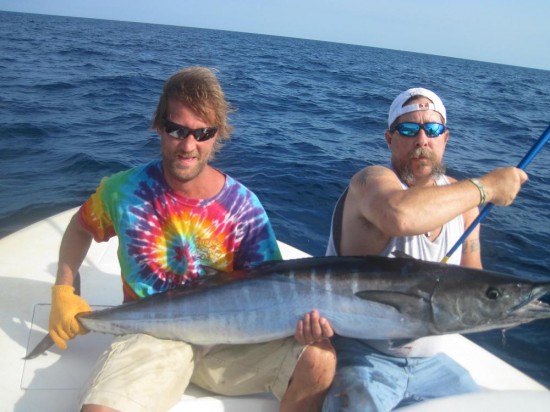
 Cast the reel so it drops alongside the pilling and drops down- if you don’t get a strike the first time keep trying until you have covered all angles before moving on.
 The Snapper, particularly the Gulf Red Snapper, is one of the most prized fish to catch in the
  Mainly used in
  1. Mold Craft Wide Range

