Hello everyone, this is Capt Steve Niemoeller with my fishing report for inshore this time. We fished around and they were just wanting to catch a variety of species and we got lucky in one spot and ended up catching 5 different species redfish ladyfish jacks and a couple others there.
It seemed like every cast was a fish on the boat, we caught all of them off of the steel shad lures it is a great bait, it was fun they had a great time hope they come back down again next year and try out some other types of fishing we do, freshwater and saltwater, for all your fresh or saltwater fishing adventures go to newsmyrnafishingcharters.com.
“Fishing has improved along Florida’s Space Coast. During the past few days, calm conditions and warmer temperatures have allowed anglers several opportunities to catch some nice fish throughout our region. To begin with, several nice speckled trout have been caught in both the Indian and Banana Rivers. Live shrimp or small scented jerk baits rigged under a popping cork has worked well during the mid-morning hours. When targeting trout, anglers can expect these fish to feed near sandy potholes in 2-4 feet of water. Anglers should keep in mind trout can be easily spooked at times. Making long casts while drifting can help increase your chances of catching a nice fish,” reports Capt. Keith Mixon of Mixin’ Work With Play Fishing Charters for this Mosquito Lagoon Fishing Report.
“A few slot size redfish have also been caught in the northern end of the Indian River. Sight casting to them has worked best during calm conditions. Live shrimp or Bass Assassin’s four inch Saltwater Assassin’s Shrimp Cocktail in Houdini or Drunk Monkey color has worked well when rigged weedless. The key to hooking up with one of these redfish is to fish the bait as slowly as possible,” Mixon reports.
“At the port, a few tripletail have been caught along the Canaveral buoy line as well as floating structure. A free lined shrimp has been the bait of choice for these hard fighting fish. Sight casting is the best way to catch them when conditions are calm during mid-day. Some of these fish have measured up to 22 inches in length,” Mixon reports.
Our Mosquito Lagoon Fishing Report allows you access to understand how the fish are moving and where you can catch Redfish. The Cape Canaveral Area is one of the best Redfish destinations in Florida. Inshore Fishing dominates and this is the perfect reason why. These river systems that make up the Lagoon provide ample fishing territory to enjoy an amazing fishing trip. Bring along your friends or families for an adventure of a lifetime on an New Smyrna Beach Fishing Charters.
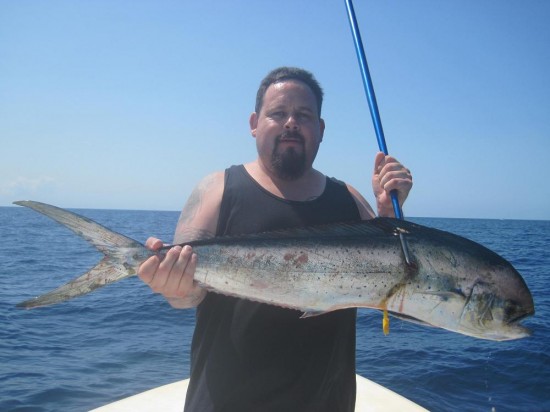
Great weather for fishing. West winds are starting to stack up some weeds offshore, and they proved to be somewhat fishy this trip. NE of the weather buoy some tightly scattered weeds proved to be just what the icebox needed. We started around the perimeter first, and the results came slowly, but good. First fish in was a 15lb Mahi. Like the last few weeks of fishing these anglers had never caught a “Dolphin”, and made it the target species of the trip. No company with this catch, so lines back to work.
Client David Bunch and his friend were traveling from Oklahoma to adventure out on a Cape Canaveral Offshore Fishing Charter with iOutdoor. They were in-store for an amazing day of fishing with great fish in the boat. You never know what to expect when Port Canaveral Offshore Trolling!
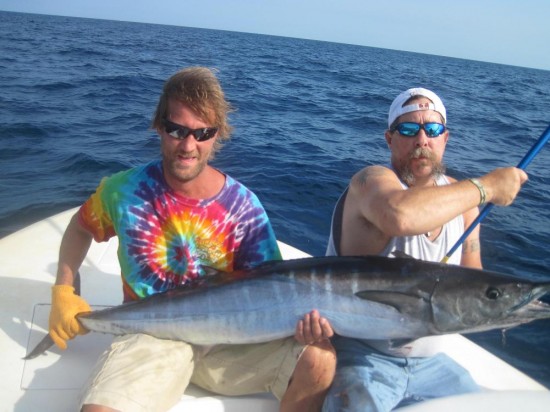
Another half hour, and the line goes off again. It did not seem too big till the angler put some bend in the rod, then a couple hundred yards of line peeled. This fish was not a jumper, but still we waited till we seen the colors to know what we had. It took a while with our Dolphin rigs to finally work it to the boat, but the Blue stripes was a very welcome sight. Wahoo in the boat. This 50lb fish made the day for these guys, and we still had time to fish.
Another pass around the area with no results, so we decided to cut through the weed field. A little time passed, and a lot of cleaning fouled lines of weed, but another hookup. Another Mahi-Mahi was on the line, dragging weeds with it. As we got it near the boat we saw it had company. The second fish did not take the other lines, so a pitch rod went to work. It looked, it followed, but nada. Other offerings were put in front of it but it turned its nose up at all we offered, and eventually made its way off. We sent
lines back out, working the weed field some more with no more action while Port Canaveral Offshore Trolling.
Finally we headed to 8A to see if we could pick up a King or two to make a Slam. One line down, another out the back, and into slow gear we went. 20 minutes into the run, the downrigger released, and drag went out. This fish came to the surface and went airborne. A nice 20 lb bull Mahi was on the line. We worked it to the boat, and about a foot short of gaff range it decided it no longer wanted to play the game, and unhooked itself. Big smiles were on the anglers faces despite the loss of this fish. With lobster red sun burnt skin, they were ready to return to port and clean fish.
‘This is a big fish! This is a big fish! This is a big fish!” It was all Jim from Delaware could yell as his drag smoked and rod arched over underneath the power of a giant redfish screaming across the shallow grass flats.
Jim along with his new fishing buddy Al Iodice of New Hampshire had already fought and boated over a dozen big redfish on the spectacular morning of fishing in the Mosquito Lagoon near Titusville, Florida, most weighing between 10 and 15 pounds. However, the beast now being battled was an all-together different class of ‘big’.
Before the sudden chaos could completely grip the situation, Capt. Rocky quickly released the hydraulic Power Pole, grabbed his graphic push pole, manned the poling platform, and began chasing down the big red beast.
Thirty minutes later, after thirty more shouts by Jim and thirty laps spun around the flats boat by Al with landing net in hand and thirty minutes of hard pushing by the captain while interspersing blurbs of instructions and bursts laughter, the 30 pounds, big bronzed beauty was finally aboard.
Afterward, with arms aching, an adrenalin-drained Jim could be heard muttering, “That was a big fish.” (Pictured below are Jim and Al smiling broadly with one really ‘big fish’.)
Taste, of course, is a matter of personal preference. Something that tastes delicious to one person may not be tasty to another. Still, there are those that are thought delicious by most people. The following are some saltwater species that a lot of people think are the best tasting fish.
This is another favorite – can be raw wherein it is soft and juicy and can be cooked in several ways, such as fried or in soup, wherein the meat is flaky and delicious.
Monk Fish
With a tail meat that tastes like lobster, this fish is considered the “poor man’s lobster”. Although the fish, itself, does not look appealing, its meat is so delicious that many people consider this a favorite.
Halibut has low fat content and is so delicious that it still tastes wonderful even with little seasoning. This fish is often broiled, grilled, or fried.
Cod
A common ingredient in “fish and chips”, the meat of this fish is moist and flaky. Its liver is also considered a delicacy.
Salmon
This is among the most popular fish – raw, smoked, or cooked. Aside from having a delicious meat, this fish is also favored because of its high nutritional value.
Tuna
Most of the tuna species have a delicious meat, high nutritional value, and delicious even when canned.
Snook are fish that live either in saltwater or fresh water. Tricky to catch, Snook are still much sought-after because of their delicious meat and the challenge of catching one. Like most fish, Snook are cold blooded animals. Thus, they rely on the water temperature to regulate the temperature of their bodies. Cold temperatures are detrimental to the health of this fish species and sudden drops in temperature can be deadly. Thus, Snook have to migrate to warmer waters such as Flamingo in the Florida Keys when winter begins.
The migration patterns largely depend on where they are currently located, what temperature that location has, and in what direction is the warmer body of water. Snook migrating through the waters of Florida follow an east to west pattern, as opposed to the usual north to south that many fish species do.
Snook can easily move from freshwater to salt water and vice versa. Those who have observed them swim upstream say that they stay close to the center of the water body – be it a large river or a small creek. Also, Snook love to travel during day time.
The problem with migrating Snook is that they ignore your bait, most of the time, no matter how delicious it might be. They are also easily spooked so fly fishing for Snook can be frustrating. In fact, Snook are the most difficult to catch when they are migrating. Still, if you try to be as subtle as you can, you’d probably be able to entice one to take your bait.
Snook Fishing in Florida:
Snook Fishing in Florida in the ultimate inshore fishing experience. You truly can’t beat the action especially once the snook move in during their migrations. Most of the migrations are due to mating and that search for warmer weather. Summer months are the most productive months to catch them but also the time of year that you can’t harvest them. According to FWC, Dec. 15- Jan. 31st and June 1st- Aug. 31st seasons of harvest are closed.
September 1st brings about one of the most incredible times to go Night Fishing in New Smyrna. Inshore Fishing for these elusive beasts will be one of the most action packed fishing adventures of your lifetime!
Sea Sickness is not a virus that is easily communicable. Yet, when people board ocean vessels or cruise ships, sea sickness is felt by majority of the passengers who have not come prepared.
What is Sea Sickness?
Sea sickness is a type of motion sickness caused by a disturbance in the vestibular system as it relates to the visual and proprioception systems of the brain. The vestibular system is the balance system found in the inner ear. Sea sickness is caused by the constant rocking motion of an ocean vessel, triggered by many factors such as focusing on close work, working in an enclosed environment, or bad smells.
Best Medications
There are a variety of medications used to prevent sea sickness. These are usually over the counter drugs which individuals can purchase freely. Among the best medications for seasickness are those that contain Meclizine, Bonine, Dramamine, and Scopolamine. These can be available in tablet or patch form.
These medications work by preventing nausea and vomiting induced by motion. These medications target the balance system of the inner ear, the vestibular system, in order for passengers to be able to perceive less the rocking motion of a vessel. It is recommended to take the medicine an hour before travel in order for it to work in time. If taken upon the start of travel, some people will find that they are still getting sea sick.
Other forms of seasickness medications include patch and wrist bands. Patches work as effectively as pills. Wrist bands, however, are used for patients who get motion sickness post-chemotherapy treatment and are not meant for sea-sickness or motion-induced sickness during ocean travel.
Florida boasts of having over 8,000 miles of coastline as well as 4,500 miles of inland waterways. With this much water for cruising, it is no wonder that boating is such a popular sport in the state. Many boaters often find themselves cruising over Florida waters and its waterways for the sheer beauty of it. Many types of boats have graced the waters of Florida ranging from mega-yachts to wooden skiffs. In Florida, owning a boat is as normal as owning a car.
Florida Waterways
The wonders of boating in Florida are further enhanced with its waterways, passages where boats can pass through for maximum boating experience. There are many waterways maintained by the Florida Inland Navigation District, the two most common and popular are the Intracoastal Waterway or ICW and the Okeechobee Waterway.
The ICW is also known as “the ditch” and is a natural but dredged channel. This channel extends 500 miles down the east coast of Florida to the tip of the Keys. This is a very popular boating route because it runs through rivers, creeks as well-dredged canals, giving boaters an extremely great variety in boating experience.
The Okeechobee Waterway, on the other hand, is composed of 135 miles of boating route. Extremely popular during the summer, this waterway runs along the St. Lucie Canal from Stuart, across the lake, then on to Sanibel Island via the Caloosahatchee River.
Just as cars park in a parking lot, boats do so as well but in ports. Boats aren’t just anchored anywhere. There are many great places to anchor in New Smyrna including across Ponce Inlet in front of sandbar of the Island; the anchorage in Boca Chica Harbor; and the bayside by Sand’s Cut. Brevard County also has a great place to anchor such as sand Island across New Smyrna Inlet.
Boating Rules and Regulations
It is recommended that before purchasing a boat or even before boating in Florida, especially for those new in the area, to get acquainted with the state’s boating rules and regulations for a safe and legal boating experience.
Mosquito Lagoon, along with Indian River Lagoon, is considered “The Redfish Capital of the World” because redfish is found there all year through. Moreover, redfish caught in the lagoon are often large so that you’d best prepare the sturdiest rod to catch this species.
Because the Mosquito Lagoon is home to Florida’s largest concentration of redfish, it is considered a premier fly-fishing destination. A lot of anglers, even those from far lands, travel to this side of the world to catch redfish. In fact, there are equipment and boats for rent on the lagoon so that these traveling anglers need not bring along their own equipment. There are also many guides offering their expertise to bring anglers to the best spots to go fishing on these shallow salt waters.
The bait
Fly fishing uses bait that resembles flies, insects, or common baits like worms and minnows. There are plenty of different types of bait and lures available in the market. Just choose the one that is the most attractive or the one that resembles common bait.
Fly fishing at the lagoon
There are certain rules to follow when fishing in the Mosquito Lagoon. A permit or license is required before anyone can start off. Also, remember that there are certain areas where angling or boats are not permitted such as in protected areas designated for manatees. It is important to know these specific areas plus where you’ll be able to get the most redfish catch.
It might take some time after you arrive at a certain portion of the lagoon to catch a redfish. Remember, the sound of the boat might have scared them away but be patient, cast your fly bait, and pretty soon the redfish will come back and bite it.

 Great weather for fishing. West winds are starting to stack up some weeds offshore, and they proved to be somewhat fishy this trip. NE of the weather buoy some tightly scattered weeds proved to be just what the icebox needed. We started around the perimeter first, and the results came slowly, but good. First fish in was a 15lb Mahi. Like the last few weeks of fishing these anglers had never caught a